Ten venomous snakes native to the United States
A field reader's guide to the rattlesnakes, copperheads, cottonmouths, and coral snakes you may meet across the country.
Most of North America's snakes cannot hurt you. Of the dozens of species you might cross paths with on a given hike, the large majority are harmless, and many of the ones people kill out of fear are doing quiet work on the local rodent population. The medically significant native venomous snakes most readers need to know fall into two main lineages. Nearly all are pit vipers: copperheads, cottonmouths, and rattlesnakes, named for the heat-sensing pits between eye and nostril. The exceptions are the coral snakes, relatives of cobras and mambas that wear their warning in bands of red, yellow, and black.
The numbers are worth holding onto first. Venomous snakes bite several thousand people in the United States each year, and with prompt medical care, fewer than ten of those bites prove fatal. A large share of the serious ones happen when somebody tries to handle or kill the snake. The animals on this list are dangerous in the narrow, specific way a power tool is dangerous. Given distance and respect, they are not looking for you.
Here are ten worth knowing on sight, from the giant of the southeastern pine woods to the desert snake that walks sideways.
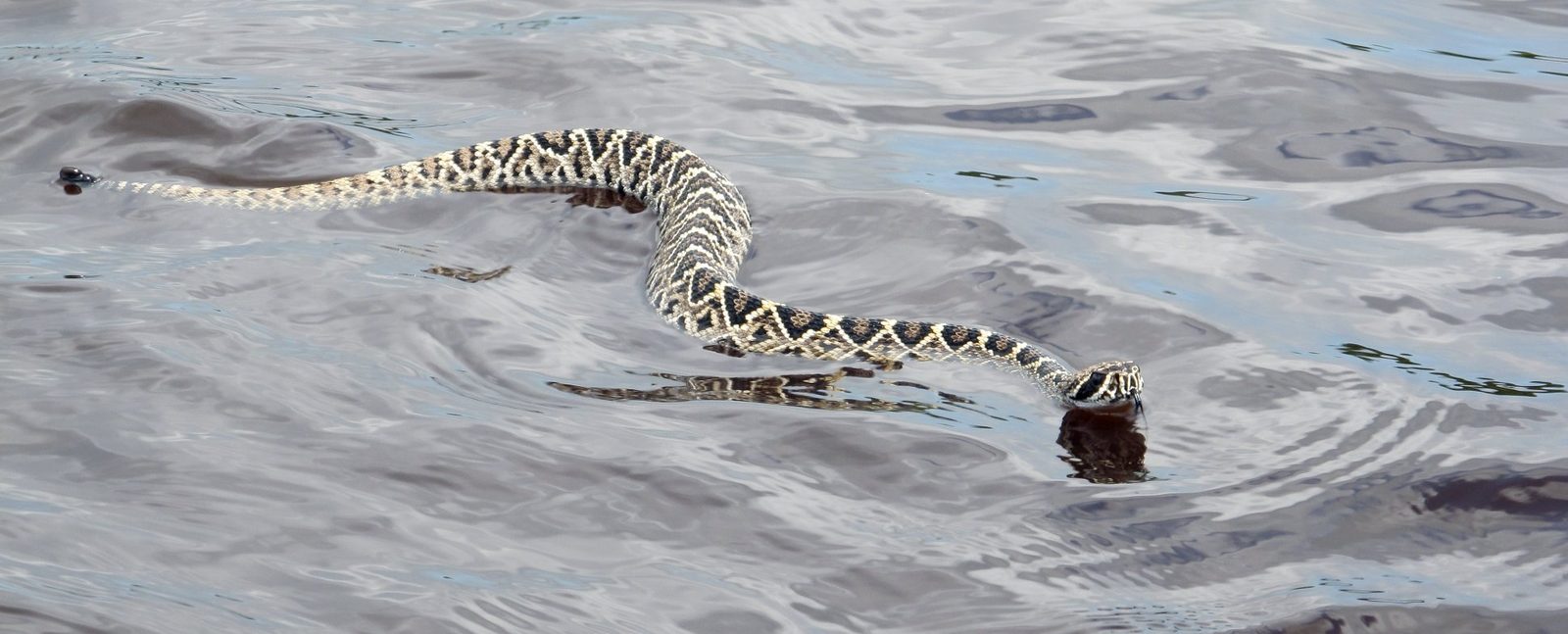
Eastern diamondback rattlesnake (Crotalus adamanteus)
The largest venomous snake in North America, and one of the largest vipers on earth. A big eastern diamondback can pass six feet and carry a head the size of a fist, set with the dark, light-bordered diamonds that name it. It lives in the longleaf pine savannas and palmetto scrub of the Deep South, from the Carolinas through Florida and along the Gulf. Its venom, delivered in large volume through fangs approaching an inch, breaks down blood and tissue, and a serious bite is a true emergency. It is also a snake in retreat. A century of habitat loss, road mortality, and organized rattlesnake roundups have driven it into steep decline, and it has been petitioned for federal protection. The giant of the pine woods is now something you are lucky to see.
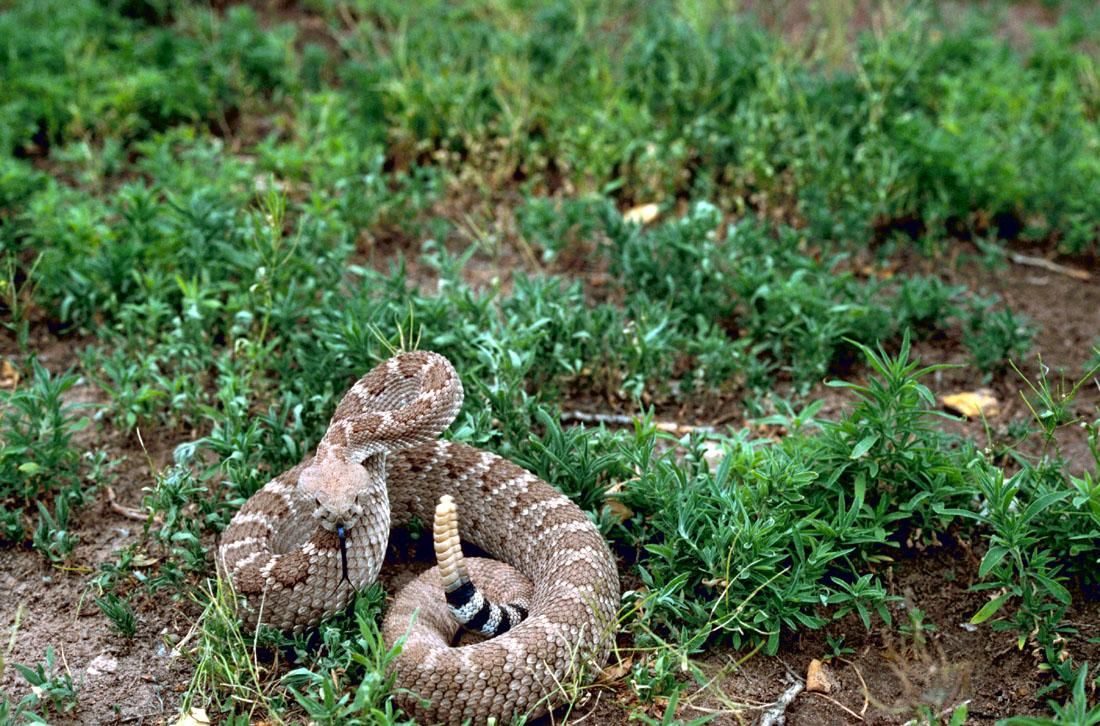
Western diamondback rattlesnake (Crotalus atrox)
If the eastern diamondback is the largest, the western is the signature rattlesnake of the arid Southwest and one of the snakes most often involved in serious bites there. It ranges from Texas and Oklahoma to Arizona and into California, thriving in the brushy, rocky, half-developed country where people also tend to live. Look for the gray-brown diamonds fading toward a bold black-and-white banded tail. It stands its ground when cornered, rattling hard, and figures prominently in serious pit viper envenomations across its range. Common, defensive, and unbothered by people is a combination worth respecting.
Timber rattlesnake (Crotalus horridus)
The rattlesnake of the eastern forests, from New England and the Appalachians down through the Southeast and west to the edge of the prairies. It is a heavy-bodied snake, usually marked with dark chevrons over yellow, gray, or near-black, and it is famously even-tempered, often giving a long warning, or none at all, rather than striking. The catch is in the venom. Across the species' range the chemistry varies, and some southern populations, the ones old-timers call canebrakes, carry a neurotoxic component closely related to the toxin that makes the Mojave rattlesnake so feared. A snake this calm being this well armed is part of why it is protected as threatened or endangered across much of the Northeast.
Mojave rattlesnake (Crotalus scutulatus)
Among the most medically concerning rattlesnakes in the United States, and the reason herpetologists talk about venom in the plural. Many Mojave rattlesnake populations carry Mojave toxin, a potent neurotoxin that goes after the nervous system rather than the tissue, and a bite can bring on weakness, drooping eyelids, and trouble breathing, sometimes hours after the local signs look mild. It is a desert snake of the Southwest, greenish to brown, and at a glance it is easy to mistake for the western diamondback, though its tail tends to carry more white than black. To complicate matters, not every population carries the neurotoxin. Some make a more ordinary tissue-destroying venom, and a few make both.
Prairie rattlesnake (Crotalus viridis)
The workhorse of the Great Plains and the high country west of them, ranging from Canada down through the Rockies and the central states into the Southwest. It is a slender, greenish-gray to brown snake with rounded blotches along the back, at home in grassland, prairie-dog towns, and rocky breaks. Across the wider West, close relatives in the former western rattlesnake complex carry similar lineages toward the Pacific, though many current taxonomies now treat those western forms separately. Its venom is the pit viper standard, tissue and blood, and it is a leading cause of bites across the plains states, often to livestock and ranch dogs as much as to people.
Sidewinder (Crotalus cerastes)
The desert's specialist, and the easiest North American snake to name by how it moves. The sidewinder throws its body across loose sand in a looping, diagonal crawl that leaves a trail of separate J-shaped marks, a gait that keeps most of it off the burning ground at any instant. It is small, pale, and cryptic, with a raised hornlike scale over each eye. It lives in the Mojave and Sonoran deserts and hunts lizards and rodents around dune and creosote. Its venom is mild as rattlesnakes go and its body is small, so it ranks low for danger, but it is one of the most distinctive snakes on the continent.
Massasauga (Sistrurus catenatus)
A small, shy rattlesnake of wet prairies, marsh edges, and fens from the Great Lakes region through the Midwest. It belongs to Sistrurus, a genus of little rattlesnakes whose rattle is so faint it has been likened to the buzz of an insect, and many people who hear one never place the sound. Its venom is potent but the amount it carries is small, and it is a retiring animal that would far rather hide than be found. The story worth telling about the massasauga is its decline. As the wetlands it depends on were drained and carved up, the snake vanished from much of its former range, and in 2016 it was listed as federally threatened. It is a reminder that the question for many of these species is no longer whether they are dangerous to us, but whether we are leaving them anywhere to live.
Copperhead (Agkistrodon contortrix)
The snake behind more venomous bites than any other in the eastern United States, and, in a strange mercy, one of the least likely to do lasting harm. The copperhead is a handsome animal, coppery tan crossed by darker hourglass bands, and it trusts that camouflage rather than flight, which is exactly why people step near it in leaf litter and woodpiles. Its venom is among the milder US pit viper venoms, and a bite, while painful and worth immediate care, is rarely life-threatening to a healthy adult. Many current taxonomies split the old copperhead into two species, the eastern copperhead and the broad-banded copperhead of the south-central states, but in the field the lesson is the same. Watch where you put your hands and feet in copperhead country.
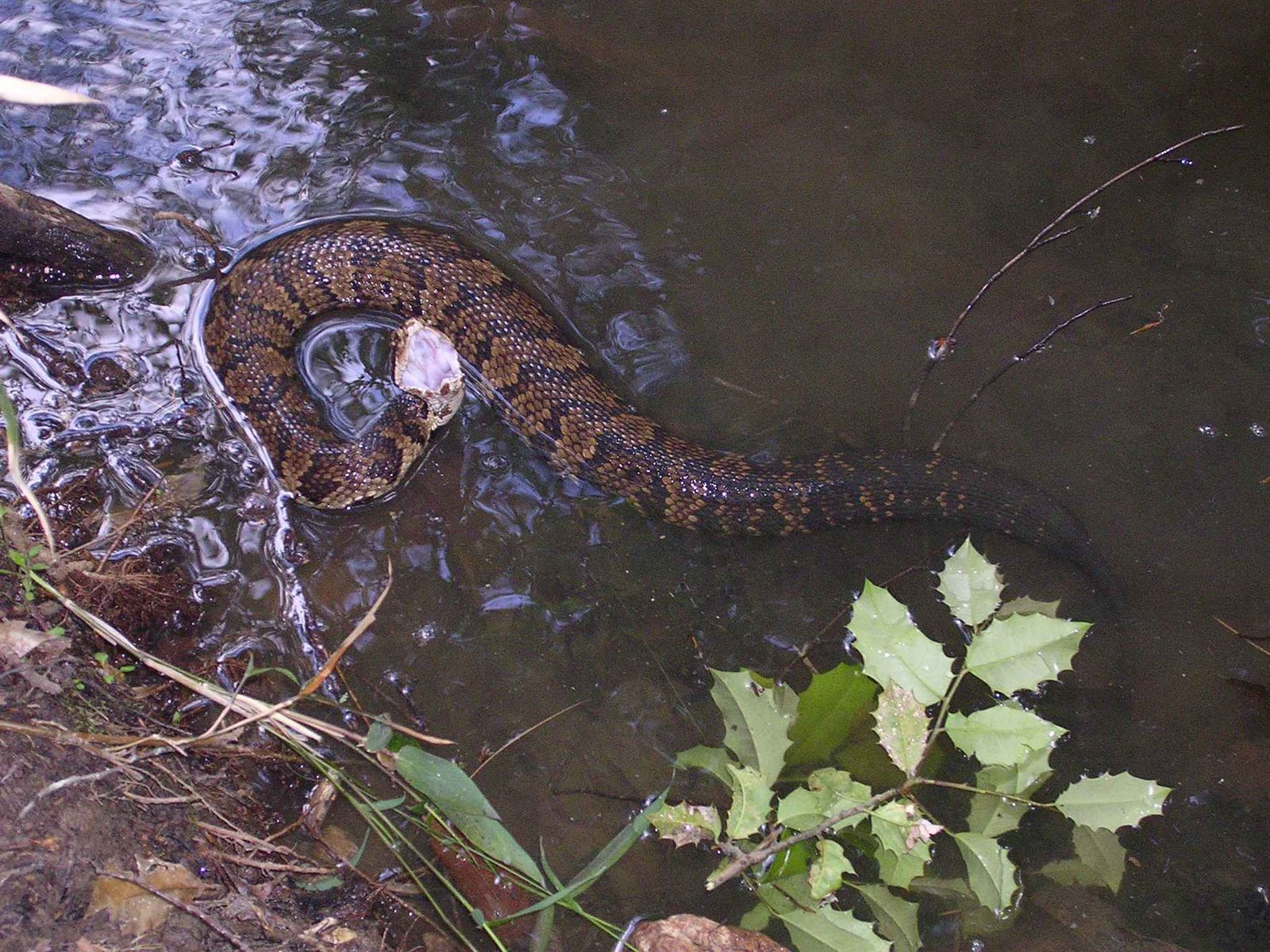
Cottonmouth (Agkistrodon piscivorus)
The semiaquatic pit viper of southeastern swamps, river edges, and flooded fields, and the subject of more bad folklore than any snake in the country. The cottonmouth, or water moccasin, is a thick, dark snake that, when threatened, throws its head back and gapes to show the startling white lining of its mouth, the display that names it. It is said to chase people. It does not. When researchers tested this directly, cottonmouths faced with a person stood their ground, gaped, or fled, but did not give chase, and most of the harmless watersnakes killed in its name were never cottonmouths at all. The venom is a typical tissue-destroying pit viper venom and a bite deserves prompt care, but the snake's reputation for aggression is the part that needs retiring.
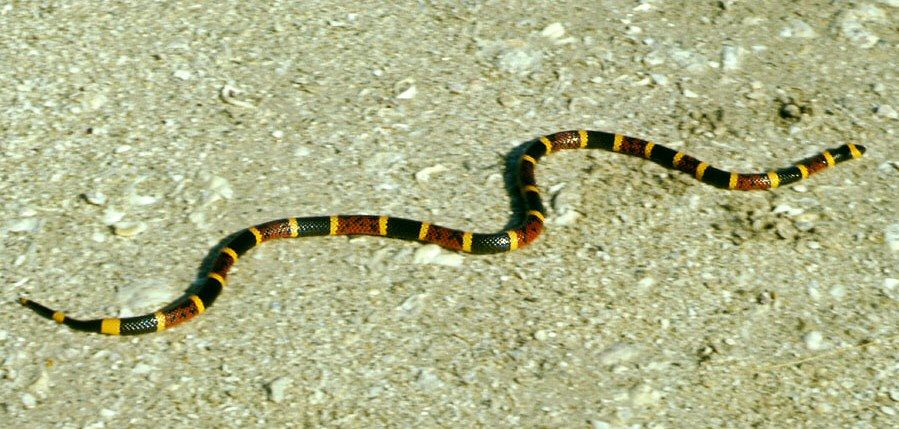
Eastern coral snake (Micrurus fulvius)
The odd one out, and the only snake on this list that is not a pit viper. The coral snake is a slender, glossy relative of the cobras, ringed in red, yellow, and black, and its venom is primarily neurotoxic, able to shut down the nerves that drive breathing. What keeps it from being a greater danger is its temperament and its mouth. It is secretive, spends much of its life underground, and has short fixed fangs, so bites are uncommon and envenomations are rare. This is the snake the old rhyme is about. Red touches yellow, kills a fellow. The pattern does hold for the native coral snakes and their harmless mimics like the scarlet kingsnake, but it is a regional accident, not a law of nature. It fails for coral snakes elsewhere in the Americas, and the only version of the rule that always works is the plain one. Do not handle a snake you cannot identify.
A few snakes that do not exist
For every real snake on this list, folklore has invented a more frightening one. There is no hoop snake that bites its tail and rolls downhill after you, no snake that milks cows, no coachwhip that runs people down and flogs them. The popular belief that a baby rattlesnake is deadlier than an adult because it cannot control its venom does not survive contact with the evidence. Young snakes carry venom and a bite from one is a real bite, but adults hold far more of it behind longer fangs, and snakes of every age meter what they inject. A notable share of defensive pit viper bites are dry, with little or no venom delivered, because venom is expensive to make and a snake would rather save it for prey. None of which is a reason to take a bite lightly, since no one can know in the moment whether a given bite was dry.
The rattle has its own mythology. A rattlesnake does not always sound off before it strikes, especially when surprised, so the absence of a buzz means nothing. And you cannot read a snake's age in years from its rattle segments, because a new segment is added at every shed and snakes shed more than once a year.
If a snake bites you
This is the one place worth being plain, and the one place where The Reptile Club is not the right authority. We are a registry and a field journal, not a medical provider, and what follows is a summary of what medical and toxicology authorities advise, not medical instruction.
The modern consensus is short. Move away from the snake so it cannot bite again, stay as calm and still as you can, take off rings, watches, and anything else that will constrict as the limb swells, keep the bitten area roughly level with the heart, and get to emergency medical care as fast as possible. The definitive treatment for a serious bite is antivenom, given in a hospital. In the United States you can reach Poison Control at 1-800-222-1222 for guidance on the way.
What has been studied and set aside matters just as much. Do not cut the wound, do not try to suck the venom out or use a suction extractor, do not apply a tourniquet, do not pack the limb in ice, and do not reach for whiskey or a stun gun. Each of those was once folk wisdom, and each has been shown to do harm with no benefit. You also do not need to catch or kill the snake. Hospitals treat the patient and the symptoms, not the specimen, and trying to capture it is a reliable way to turn one bite into two.
Worth more alive
It is tempting, meeting a venomous snake, to reach for a shovel. It is also how a large share of bites actually happen, because the moment of greatest danger is almost always the moment a person decides to close in. Left alone, every animal on this list would rather you pass.
Several of them are in trouble. The eastern diamondback has been pushed toward the edge of its range by habitat loss and roundups, the massasauga is federally threatened, and the timber rattlesnake is protected across much of the Northeast. They earn their place the way most predators do, by holding down the rodents that would otherwise flourish, along with the ticks and the crop damage that follow them. A rattlesnake in the woods behind the house is, in the most practical terms, working for you.
Knowing them on sight is not about fear. It is the first step toward the thing that actually keeps both sides safe, which is enough room, and the willingness to let a dangerous animal simply go about being one.